▲ CNC design copilot
Describe the thing. Get cut-ready files.
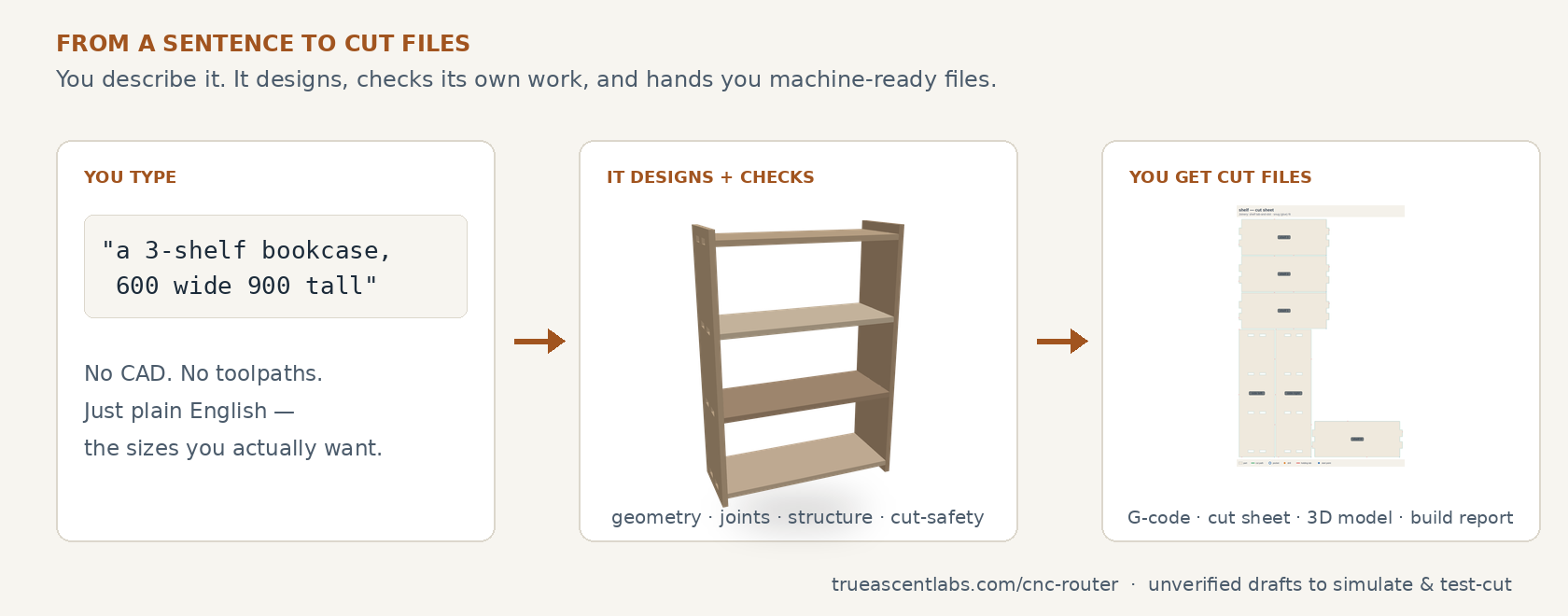
A desktop CNC router is a capable machine — but the moment you want to make something, a second machine gets in the way: the CAD/CAM software. This tool takes a plain-English description — “a 4-shelf bookcase 800 wide” — and walks it all the way to a checked design and machine-ready cut files, so a capable machine stops sitting idle behind software you never wanted to learn.
You steer the direction and do the final physical test cut. It does the CAD/CAM middle that normally eats an evening.
More than a template gallery
Made-to-measure
It reasons about the specific piece — working out sensible dimensions, joints, and layout from a loose description — so a shelf that fits this alcove is no harder than a stock size. Nothing here was ever a fixed template.
It checks its own work
Before you ever see cut files: geometry sanity, whether the piece is structurally sound for its job, whether the joints will actually seat, and whether the cut program is safe to stream to the machine.
It fixes its own mistakes
When a check fails, it tries to repair the design itself and re-checks — nudge the layout, rotate a part, split across sheets, deepen a shelf — instead of handing the problem back to you.
Honest about the edges
The handful of things only a real test cut can confirm — actual stock thickness, real-world fit feel, workholding — are called out on every build, not papered over. Outputs are drafts to test-cut, never “safe to run” unseen.
Well past flat-pack now
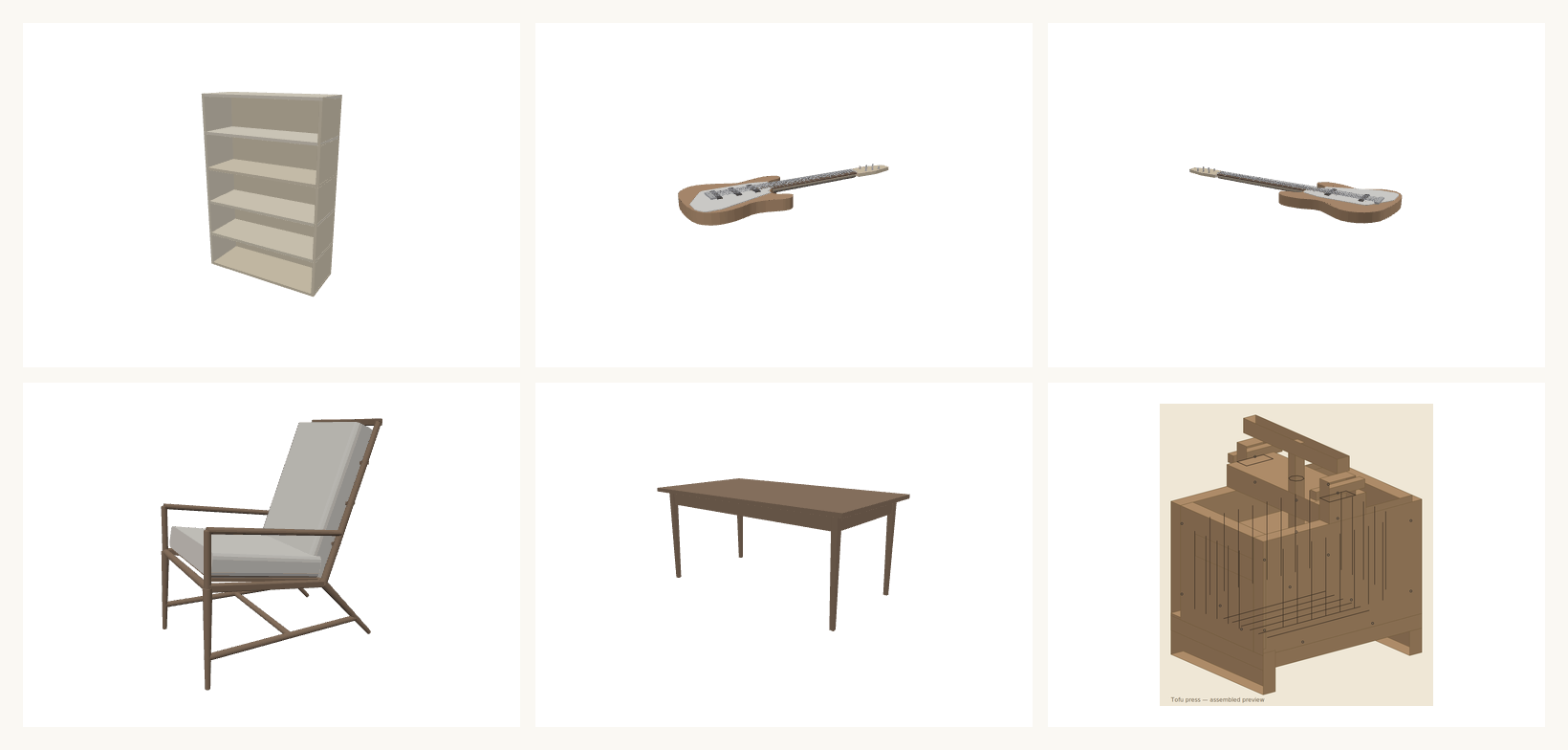
It started with sheet-good joinery, but the same describe → design → check → cut-files pipeline now drives objects nobody would call flat-pack — and two of them are worth calling out.
A whole guitar, not just a body
The instrument engine builds a complete solid-body electric — body, neck, and headstock — from a spec, across seven traced outlines (Stratocaster, Telecaster, Les Paul, Flying V, offsets) and basses too. Real scale length and fret spacing, a radiused fretboard, pickguard and cavities, each run through the same validation and G-code gates as everything else.
A second track: solid-hardwood furniture
Alongside the flat-pack line, a real-wood track designs mid-century chairs and tables and flat-board classics — an Adirondack, a rocker, a porch glider — with loose-tenon joinery, tapered legs, and a per-piece build report and cut list. Prototype in cheap pine; build it in walnut.
The machines got cheap years ago. The missing key was design.
Local, on-demand making has been “about to happen” for fifteen years — the hardware got cheap and genuinely good. What never fell was the design barrier: you still had to design the thing and think in CAD, toolpaths, kerf, tabs, and cut order. So capable machines sat idle. Moving that barrier — letting a normal person originate a design for their own space and skill — is the whole point of this one.
How it works
- Describe it in plain EnglishA sentence — a bookshelf, a joined box, a bit of flat-pack furniture, a hardwood chair, a 2.5D sign, a whole guitar. It turns that into a validated design and tells you the assumptions it made, asking only when something critical is genuinely ambiguous.
- It designs and checks, not improvisesTrusted parametric generators draw the real geometry; the machine-critical math lives in code, not in improvised text. A self-correcting loop runs the geometry, structure, joint-fit, and cut-safety checks — and repairs the design when one fails.
- Out come files you can test-cutMachine-ready G-code, a flat cut sheet, an interactive 3D model to look the design over, an assembly guide, and a one-page build report with conservative feeds and an honest confidence tier. You load them into your sender and cut.
Where it stands
Early but real — and the range keeps widening. The end-to-end path — plain-English request → validated design → cut files — now spans flat-pack joinery and cabinetry, a library of generative CNC-native shelving, whole electric guitars and basses, and a solid-hardwood furniture track, all through the same self-checking, self-correcting loop with an in-browser 3D preview before you cut. It’s still firmly in the “steer it and test-cut it yourself” stage, not a polished product — and the next real milestone is a library of physical test cuts on a real machine.
Working name only. Aimed at a hobby-grade 3-axis router — sheet-good joinery and flat-pack furniture, solid-hardwood chairs and tables, 2.5D art, and whole instruments — not free-form 3D sculpture. Every cut program is an unverified draft to simulate and test-cut; the tool makes a file, you run the machine.
Be the first to cut with it.
There’s no app to sign into yet. Leave an email and I’ll send one note when there’s something real to try — plus the occasional build-in-public update as the physical test cuts happen. That’s it.
Your email is used only to tell you about this project — never sold, and you can ask to be removed anytime. Prefer to just talk? Get in touch.
